
- India
- Jul 01
- Sreesha V.M
Samagra Shishu Bal Swasthya Karyakram (SSBSK)
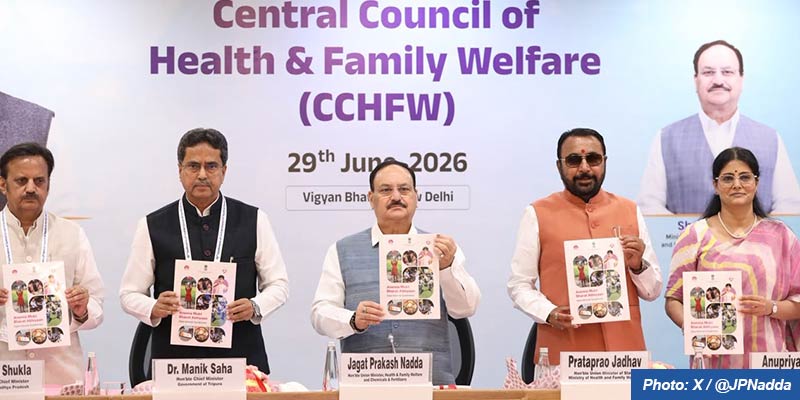
• Union Minister of Health and Family Welfare J.P. Nadda launched the Samagra Shishu Bal Swasthya Karyakram (SSBSK).
• Nadda launched the programme at the 16th Conference of the Central Council of Health and Family Welfare (CCHFW) in New Delhi on June 29.
Highlights of SSBSK:
• The programme embodies the vision of ‘Pehle Teen Saal Sampoorna Dekhbhal’ (Comprehensive Care During the First Three Years) by integrating the existing Home-Based Newborn Care (HBNC) and Home-Based Care for Young Child (HBYC) programmes into a single comprehensive framework.
• The initiative recognises the critical importance of the first 28 days for newborn survival and the first three years for optimal brain development, while strengthening child survival, nutrition, healthy growth and early childhood development through an integrated approach.
• The programme strengthens continuity of care through coordinated home visits by Accredited Social Health Activists (ASHAs), Auxiliary Nurse Midwives (ANMs), Community Health Officers (CHOs) and Anganwadi Workers (AWWs).
• A key feature of SSBSK is the introduction of a risk-stratified approach for newborns and young children identified as “at-risk” due to conditions such as low birth weight, prematurity, delayed initiation of breastfeeding, discharge from newborn care units, malnutrition, recurrent illness or developmental delays.
• These children will receive intensified follow-up through additional home visits tailored to their level of risk.
• Under the programme, “at-risk” newborns will receive up to nine home visits during the first 42 days of life, while “at-risk” children will receive up to eight home visits up to the age of 36 months.
• To strengthen early identification and management of vulnerable children, SSBSK introduces Well-Baby Sessions at every Village Health, Sanitation and Nutrition Day (VHSND) and a monthly Shishu Shivir at Ayushman Arogya Mandirs.
• These platforms will facilitate regular screening, developmental assessment and comprehensive management of newborns and young children within the community.
• SSBSK incorporates post-partum maternal mental health screening as an integral component of community-based care.
• The programme also mainstreams Nurturing Care for Early Childhood Development (ECD) by promoting responsive caregiving, early learning opportunities, age-appropriate play, child safety and active family engagement during every home visit and community interaction.
• Decision-Support Systems (DSS), child-wise digital tracking, referral mechanisms and alert systems will strengthen follow-up and case management of “at-risk” newborns and children.
• These digital systems will be integrated with national digital health platforms, including the JANANI (Journey of Antenatal, Natal and Neonatal Integrated Care) portal, U-WIN Portal, MPCDSR (Maternal, Perinatal, Child Death Surveillance and Review) portal, Rashtriya Bal Swasthya Karyakram (RBSK) 2.0 Portal and POSHAN tracker, enabling seamless data exchange through Ayushman Bharat Health Account (ABHA) and Baal-ABHA IDs.
• The guidelines will also address emerging challenges of the digital era by promoting age-appropriate play, physical activity and mental stimulation during the first three years of life while recognising the adverse impact of excessive screen time and reduced physical interaction on brain development, emotional health and social skills.
(The author is a trainer for Civil Services aspirants.)