
- India
- Sep 10
- Sreesha V.M
Govt launches 9th Rashtriya Poshan Maah
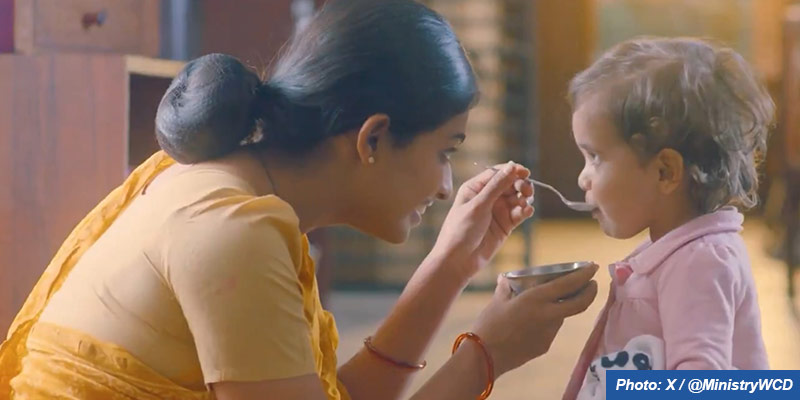
• Union Women and Child Development Minister Annpurna Devi launched the ninth Rashtriya Poshan Maah (National Nutrition Month) 2026 in Varanasi on September 9.
• The month-long campaign was launched at the Rudraksh International Cooperation and Convention Centre in the presence of Uttar Pradesh Chief Minister Yogi Adityanath, Minister of State for Women and Child Development Savitri Thakur and Uttar Pradesh Women Welfare, Child Development and Nutrition Minister Baby Rani Maurya.
What is Rashtriya Poshan Maah?
• Rashtriya Poshan Maah is observed every September as a dedicated platform to mobilise communities and reinforce key nutrition, health and caregiving behaviours among pregnant women, lactating mothers, children, adolescents, and their families.
• The 9th Poshan Maah 2026 highlights the importance of anganwadi centres.
• The theme is “Hamari Anganwadi Hamari Jimmedari”, which calls upon citizens to take shared ownership of anganwadi centres as the first point of nutrition, health, care and early learning for children.
• Over successive Poshan Maah campaigns, awareness and positive behaviour change have been strengthened on maternal nutrition, infant and young child feeding (IYCF) practices, growth monitoring and hygiene, alongside broader efforts to improve nutrition outcomes across the country.
The campaign will focus on five themes:
i) Dietary diversity and adequate protein.
ii) Fresh hot cooked meals at anganwadi centres.
iii) Community ownership and accountability.
iv) Nutrition, early stimulation and education for childhood development.
v) Celebrate 10 years of the Pradhan Mantri Matru Vandana Yojana (PMMVY), India’s flagship maternity benefit programme.
• This year’s campaign draws momentum from the revised Supplementary Nutrition Programme (SNP) guidelines, which for the first time define hot cooked meals and mandate SNP menu boards.

Mission Poshan 2.0
• For several decades, nutrition interventions in India were implemented through multiple schemes, targeting different groups, across different ministries.
• While these addressed different aspects of nutrition, the approach remained largely sector specific.
• Over time, the need for convergence and coordinated implementation was recognised.
• The Integrated Child Development Services (ICDS), launched in 1975, provided the foundational platform for supplementary nutrition, health services and early childhood care through anganwadi centres.
• Recognising that the health of a mother is a critical factor in ensuring the health and nutrition of her child, Pradhan Mantri Matru Vandana Yojana (PMMVY) was launched in 2017.
• This scheme introduced maternity benefits through direct cash transfers, thus providing financial support for pregnant and lactating mothers.
• In the same year, NITI Aayog’s National Nutrition Strategy (2017) emphasised convergence, improved monitoring and community participation, and recommended a mission-mode approach.
• In 2018, the government of India launched POSHAN Abhiyaan (Prime Minister’s Overarching Scheme for Holistic Nourishment) as a multi-ministerial convergence mission placing nutrition at the centre of the development agenda.
• The Union Budget 2021-22 further consolidated India’s fragmented nutrition initiatives under Mission Poshan 2.0 (Mission Saksham Anganwadi and Poshan 2.0), creating a unified and integrated framework.
It consolidates three core schemes into one framework:
i) POSHAN Abhiyaan (Technology-driven monitoring, Jan Andolan mass mobilisation, and behavioural change).
ii) Anganwadi Services/ Integrated Child Development Services (ICDS) (Supplementary nutrition, hot cooked meals, and early childhood care).
iii) Scheme for Adolescent Girls (Nutritional support for out-of-school/ adolescent girls).
• The consolidation sharpened the focus on maternal nutrition, infant and young child feeding (IYCF) norms, and the treatment of Severe Acute Malnutrition (SAM)/ Moderate Acute Malnutrition (MAM).
• It also emphasised wellness through AYUSH-based practices to reduce wasting, stunting, anaemia and underweight prevalence.
The mission is re-structured and operates through the following primary verticals:
i) Nutrition Support for children, pregnant women &lactating mothers and adolescent girls.
ii) Early Childhood Care and Education (3-6 years) and early stimulation for (0-3 years)
iii) Anganwadi Infrastructure including upgradation of centres into Saksham Anganwadi.
(The author is a trainer for Civil Services aspirants.)