
- India
- Sep 22
- Sreesha V.M
Scientists discover leafless ‘ghost flower’ orchid in Arunachal Pradesh
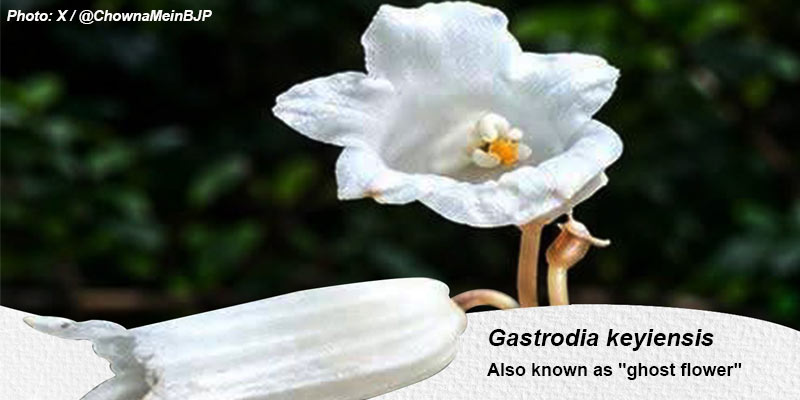
• Scientists have discovered a rare leafless orchid species — Gastrodia keyiensis — in a remote gorge along the Keyi River in Arunachal Pradesh’s Keyi Panyor district.
• The species has been named Gastrodia keyiensis, with the specific name derived from the Keyi River, where it was discovered.
• It belongs to the genus Gastrodia, a group of orchids known for their unusual non-photosynthetic lifestyle.
• The orchid was found at an altitude of around 1,000 metres, with only five flowering individuals recorded during the botanical survey.
• The new species has been formally described in the international taxonomic journal Phytotaxa in a research paper.
• The researchers are affiliated with institutions including the G.B. Pant National Institute of Himalayan Environment, Sikkim University, Kaliabor College and the Botanical Survey of India.
• The state has been described as an “Orchid Paradise of India” because of its high orchid diversity, while its varied elevations, climate and forest habitats provide suitable conditions for a wide range of plant species.
Key points on Gastrodia keyiensis:
• In the Nyishi dialect, the orchid is locally known as “Oram Opuh”, meaning “ghost flower”.
• The name reflects its unusual appearance and its tendency to remain concealed for most of its life cycle.
• Unlike most plants, these orchids do not produce food through photosynthesis. Instead, they obtain nutrients through associations with fungi in the soil, a condition known as holomycotrophy.
• The orchid was found growing in deep shade on thick layers of decaying leaf litter in bamboo groves along the right bank of the Keyi River.
• The plants can grow up to about 35 cm in height and produce one to three flowers.
• The flower is particularly unusual because much of the plant’s life is spent hidden beneath the forest floor.
• Lacking leaves and chlorophyll, Gastrodia keyiensis is adapted to the dark, humid conditions of the forest floor and depends on its fungal association for nourishment.
• Its flowers are white to pale bluish, with a distinctive yellow and strongly curved portion of the labellum.
• The orchid’s elusive nature, short flowering period and long underground phase make it difficult to detect during routine botanical surveys.
(The author is a trainer for Civil Services aspirants.)