
- India
- Oct 14
NPCI postpones levy of MDR on UPI transactions
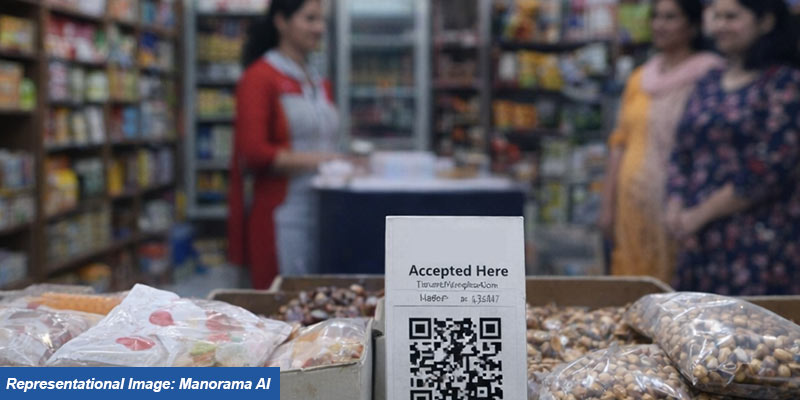
• The decision to levy a Merchant Discount Rate of 0.4 per cent on UPI transactions over Rs 2,000 has been deferred keeping in mind the festive season, the National Payments Corporation of India (NPCI) announced on October 13.
• A new date for the implementation will be decided after Diwali.
What is Merchant Discount Rate?
• In September, the NPCI announced that a 0.4 per cent Merchant Discount Rate (MDR) will be levied on person-to-merchant (P2M) transactions above Rs 2,000 through Unified Payments Interface (UPI).
• The Merchant Discount Rate (MDR) is a fee charged by payment processors, banks, or card networks to business owners for processing digital payments by a customer.
• In January 2020, to promote digital transactions, MDR was made zero for BHIM-UPI transactions through amendments in Section 10A in the Payments and Settlement Systems Act, 2007 and section 269SU of the Income-tax Act, 1961.
• Data analysis indicates that MDR will apply to only about 4 per cent of merchant transactions.
• This means that approximately 96 per cent of merchant transactions will remain unaffected, as they are either below the Rs 2,000 threshold or covered by the zero-MDR framework for small merchants.
• For transactions of Rs 75,000 and above, the MDR will be capped at Rs 300 per transaction.
• Transactions above Rs 2,000 in essential and thin-margin sectors, including railways, telecommunications, insurance, fuel and agricultural inputs, will attract a flat MDR of Rs 5 per transaction.
• Payments relating to mutual funds, securities, stockbrokers and dealers will attract an MDR of 0.02 per cent, capped at Rs 300 per transaction.
• Banks have been advised to ensure that merchants do not pass MDR charges on to customers.
• The finance ministry clarified that MDR is neither a tax nor a charge collected by the government or NPCI.
• It is distributed among payment ecosystem participants, including banks and payment application providers, to further invest into infrastructure resiliency, innovation and cybersecurity.
National Payments Corporation of India
• National Payments Corporation of India (NPCI) was incorporated in 2008 as an umbrella organisation for operating retail payments and settlement systems in India.
• It is an initiative of the Reserve Bank of India (RBI) and Indian Banks’ Association (IBA) under the provisions of the Payment and Settlement Systems Act, 2007, for creating a robust Payment & Settlement Infrastructure in India.
• Considering the utility nature of the objects of NPCI, it has been incorporated as a not-for-profit company, with an intention to provide infrastructure to the entire banking system in India for physical as well as electronic payment and settlement systems.
• The company is focused on bringing innovations in the retail payment systems through the use of technology for achieving greater efficiency in operations and widening the reach of payment systems.
• NPCI is focused on bringing innovations in the retail payment systems through the use of technology and is working to transform India into a digital economy. It is facilitating secure payment solutions with nationwide accessibility at minimal cost in furtherance of India’s aspiration to be a fully digital society.
• NPCI International Payments Limited (NIPL) was incorporated on April 3, 2020, as a wholly-owned subsidiary of NPCI. As the international arm of NPCI, NIPL is devoted for deployment of NPCI’s indigenous, successful real-time payment system — UPI, and card scheme – RuPay, outside of India.