
- World
- May 23
Setback for Britain over Chagos islands
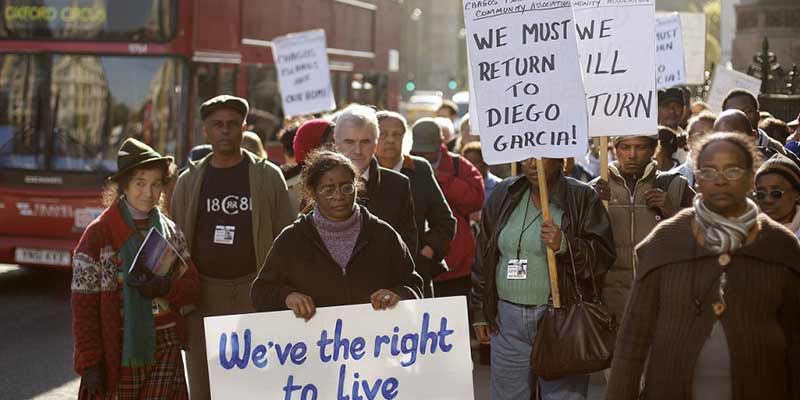
The UN General Assembly has passed a resolution demanding the UK to withdraw its “colonial administration” from the Chagos Archipelago unconditionally within six months. India was among 116 nations to vote in favour of the resolution supporting Mauritius in its quest for the restoration of sovereignty over the island chain in the Indian Ocean.
The General Assembly adopted the ‘Advisory opinion of the International Court of Justice on the legal consequences of the separation of the Chagos Archipelago from Mauritius in 1965’ resolution on May 22 with 116 votes in favour, 56 abstentions and six nations voting against, including the UK, the US, Australia, Israel and the Maldives.
Why is there a row over this island?
The UK retained sovereignty over the islands after Mauritius gained its independence from Britain in 1968. The islands have since been used for defence purposes by the UK and the US, which established a military base on the island of Diego Garcia. The entire Chagossian population was forcibly removed from the territory between 1967 and 1973, and prevented from returning.
US planes have been sent from the base to bomb Afghanistan and Iraq. The facility was also reportedly used as a “black site” by the CIA to interrogate terrorism suspects. In 2016, the lease for the base was extended until 2036.
Mauritius Prime Minister Pravind Kumar Jugnauth told the UNGA meeting that the findings of the International Court of Justice (ICJ) show the “gravity and extent” of the wrongful act under international law that the colonial power has committed in carrying out the excision of the Chagos Archipelago from Mauritius in 1965 and maintaining the islands as a colony ever since.
UK permanent representative to the UN Ambassador Karen Pierce told the General Assembly that Britain is not in doubt about its sovereignty over the British Indian Ocean territory. “It has been under continuous British sovereignty since 1814. Contrary to what has been said today, it has never been part of the Republic of Mauritius,” she said.
Pierce added that the joint UK and US defence facility on the British Indian Ocean Territory plays a vital role in its efforts to keep “our allies and friends, including Mauritius, in the region, and beyond, safe and secure”.
Who backed the UK against the resolution?
The US, Hungary, Israel, Australia and the Maldives backed the UK in the vote and 56 countries, including France, Germany, the Netherlands, Portugal, Poland and Romania, abstained. Other European allies, including Austria, Greece, Ireland, Spain, Sweden and Switzerland, voted for the UK to relinquish sovereignty. The scale of the defeat for the UK and US came as a surprise even to Mauritius, in view of the concerted campaign pursued by London and Washington.
The resolution welcomed the February 25, 2019 advisory opinion of the ICJ on the legal consequences of the separation of the Chagos Archipelago from Mauritius in 1965. The principal judicial body of the UN had said in its opinion that the UK government is “under an obligation” to end its administration of the Chagos Archipelago “as rapidly as possible”.
The resolution affirmed, in accordance with the advisory opinion of the ICJ, that the Chagos Archipelago forms an integral part of the territory of Mauritius. It demanded that the UK withdraw its colonial administration from the Chagos Archipelago unconditionally within six months, enabling Mauritius to complete the decolonisation of its territory as rapidly as possible.
What is India’s stand?
India voted in support of the resolution, with its permanent representative to the UN Ambassador Syed Akbaruddin telling the General Assembly that “as part of New Delhi’s long-standing support to all peoples striving for decolonisation, India has consistently supported Mauritius in its quest for the restoration of sovereignty” over the Chagos Archipelago. “In accordance with our consistent approach on this important issue of decolonisation, India supports the draft resolution, submitted by Senegal on behalf of members of the Group of African States. India, therefore, will vote in favour of the draft resolution,” he said. Mauritius is a fellow developing country from Africa, with which India has age-old people-to-people bonds, he said.
Akbaruddin said the ICJ, the highest international legal authority that can consider such issues, has advised that all member states are under an obligation to cooperate with the UN in order to complete the decolonisation of Mauritius.
“India shares, with the international community, security concerns relating to the Indian Ocean. We are conscious of the need for collective commitment towards ensuring the security and prosperity of our oceanic space. However, this is a separate matter on which we urge the concerned governments to reach a mutually agreeable understanding as soon as possible,” Akbaruddin said.