
- World
- Jun 13
India slips to 141 in Global Peace Index
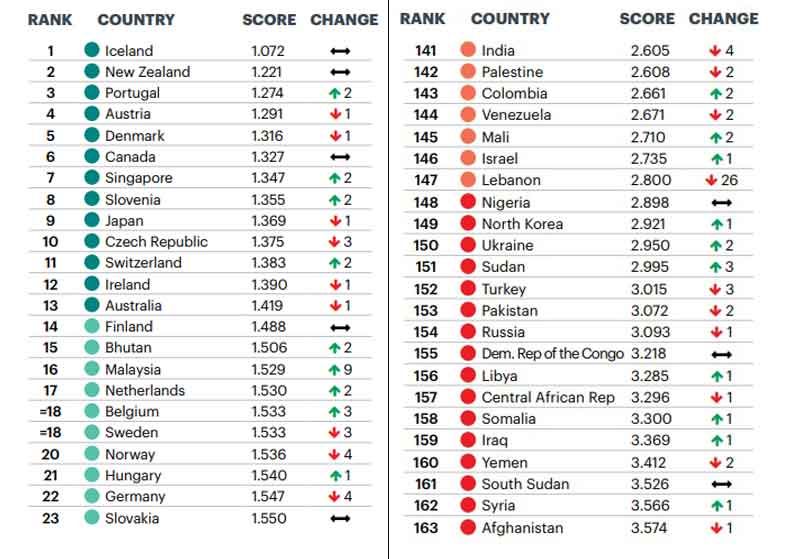
India has slipped by four points in an annual global index on peacefulness this year, finishing at 141 among 163 countries. Iceland remains the most peaceful country in the world, a position it has held since 2008, the Institute for Economics and Peace (IEP) said in a statement.
The 13th edition of the annual report, the world’s leading measure of global peacefulness, also shows that the “average level of global peacefulness improved for the first time in five years”, the statement said. “However, despite improvement, the world remains considerably less peaceful now than a decade ago, with the average level of peacefulness deteriorating by nearly four per cent since 2008,” the report claimed.
What are the indicators of peace index?
The Global Peace Index (GPI) gauges ongoing domestic and international conflict, safety and security in society, and the degree of militarisation in 163 countries and territories by taking into account 23 indicators.
The report covers 99.7 per cent of the world’s population and uses 23 qualitative and quantitative indicators from highly respected sources to compile the index. These indicators are grouped into three key domains — ongoing conflict, safety and security, and militarisation, the IEP said.
The IEP is an international and independent think tank dedicated to shifting the world’s focus to peace as a positive, achievable and tangible measure of human well-being and progress.
Which are the top countries on GPI?
Iceland is joined at the top of the index by New Zealand, Austria, Portugal, and Denmark. Bhutan has recorded the largest improvement of any country in the top 20, rising 43 places in the last 12 years. Eighty-six countries improved their score in the 2019 report, while 76 deteriorated.
Afghanistan is now the least peaceful country in the world, replacing Syria, which is now the second least peaceful. South Sudan, Yemen, and Iraq comprise the remaining five least peaceful countries, it said. This is the first year since the inception of the index that Yemen has been ranked amongst the five least peaceful countries.
The report also claimed that the gap between the least and most peaceful countries “continues to grow”.
It also stated that 72 countries reduced their level of military expenditure as a percentage of GDP in the 2019 GPI, with the majority of the largest improvements occurring in countries in sub-Saharan Africa, South America, and the Middle East and North Africa.
How climate change affects peace?
The 2019 report also includes new research on the possible effects of climate change on peace.
Climate change can indirectly increase the likelihood of violent conflict through its impacts on resource availability, livelihood, security and migration. In order to address these challenges, there will need to be much greater cooperation both within and between countries. Countries with high levels of Positive Peace are better able to manage climate-induced shocks and tend to have higher environmental performance than those with lower levels of Positive Peace.
An estimated 971 million people live in areas with high or very high climate change exposure. Of this number, 400 million (41 per cent) reside in countries which already have low levels of peacefulness.
“India’s rank has moved down to 141 from in GPI 2019 (from its previous position at 136), among 163 countries, and it stands at fifth in the (South Asian) region. India together with the Philippines, Japan, Bangladesh, Myanmar, China, Indonesia, Vietnam and Pakistan are the nine countries with the highest risk of multiple climate hazards. India has the seventh highest overall natural hazard score,” the report added.