
- World
- Oct 09
Work on cosmology wins physics Nobel
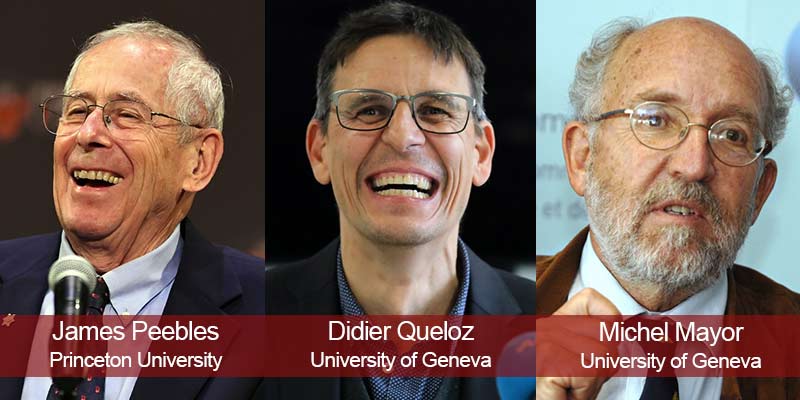
Canadian-American cosmologist James Peebles and Swiss astronomers Michel Mayor and Didier Queloz have won the Nobel Physics Prize for research that increases the understanding of our place in the universe.
Peebles won one-half of the prize “for theoretical discoveries that have contributed to our understanding of how the universe evolved after the Big Bang”, said professor Goran Hansson, secretary general of the Royal Swedish Academy of Sciences.
Mayor and Queloz shared the other half for the first discovery, in October 1995, of a planet outside our solar system - an exoplanet - orbiting a solar-type star in the Milky Way.
“Their discoveries have forever changed our conceptions of the world,” the jury said.
Insights into physical cosmology
Peebles, 84, is the Albert Einstein Professor of Science at Princeton University in the US.
Developed over two decades since the mid-1960s, Peebles’ theoretical framework is “the basis of our contemporary ideas about the universe”.
Peebles built upon Einstein’s work on the origins of the universe by looking back to the millenia immediately after the Big Bang, when light rays started to shoot outwards into space.
The Big Bang model describes the universe from its very first moments, almost 14 billion years ago, when it was extremely hot and dense. Since then, the universe has been expanding, becoming larger and colder.
Barely 400,000 years after the Big Bang, the universe became transparent and light rays were able to travel through space. Even today, this ancient radiation is all around us and, coded into it, many of the universe’s secrets are hiding.
Using his theoretical tools and calculations, Peebles was able to interpret these traces from the infancy of the universe and discover new physical processes.
His work showed that the matter known to us - such as stars, planets and ourselves - only make up 5 per cent, while the other 95 per cent are made up of “unknown dark matter and dark energy”.
“Although the theory is very thoroughly tested, we still must admit that the dark matter and dark energy are mysterious,” Peebles said.
The hunt for unknown planets
In October 1995, Mayor and Queloz announced the first discovery of a planet outside our solar system, an exoplanet, orbiting a solar-type star in our home galaxy, the Milky Way.
At the Haute-Provence Observatory in southern France, using custom-made instruments, they were able to see planet 51 Pegasi b, a gaseous ball comparable with the solar system’s biggest gas giant, Jupiter.
This discovery started a revolution in astronomy and more than 4,000 exoplanets have since been found in the Milky Way. Strange new worlds are still being discovered, with an incredible wealth of sizes, forms and orbits. They challenge our preconceived ideas about planetary systems and are forcing scientists to revise their theories of the physical processes behind the origins of planets, the jury said.
With numerous projects planned to start searching for exoplanets, we may eventually find an answer to the eternal question of whether other life is out there.
Mayor, 77, and Queloz, 53, are both professors at the University of Geneva. Queloz also works at the University of Cambridge.
The prize consists of a gold medal, a diploma and the sum of 9 million Swedish kronor (about $914,000).
The trio will receive the prize from King Carl XVI Gustaf in Stockholm on December 10, the anniversary of the 1896 death of scientist Alfred Nobel who created the prizes in his last will and testament.
In 2018, the honour went to Arthur Ashkin of the US, Gerard Mourou of France and Donna Strickland of the US for laser inventions used for advanced precision instruments in corrective eye surgery and in industry.