
- World
- May 06
Cynthia Rosenzweig wins 2022 World Food Prize
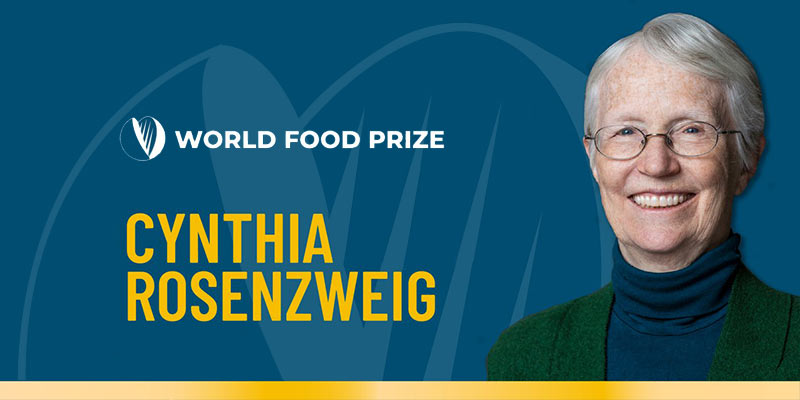
• Leading climatologist and agronomist Dr. Cynthia Rosenzweig has been named the 2022 World Food Prize Laureate for her pioneering work in modeling the impact of climate change on food production worldwide.
• Awarded by the World Food Prize Foundation, the $250,000 prize honours Rosenzweig’s achievements as the founder of the Agricultural Model Intercomparison and Improvement Project (AgMIP), a globally integrated transdisciplinary network of climate and food system modelers.
• AgMIP is dedicated to advancing methods for improving predictions of the future performance of agricultural and food systems in the face of climate change, providing the evidence base for effective food system transformation.
• Her leadership of AgMIP has directly helped decision-makers in more than 90 countries enhance their resilience to climate change.
The World Food Prize
• Nobel Prize laureate Norman Borlaug established the World Food Prize in 1986.
• The World Food Prize is a prestigious international award conceived as the “Nobel Prize for Food and Agriculture”.
• It is awarded for a specific, exceptionally significant, individual achievement that advances human development with a demonstrable increase in the quantity, quality, availability of, or access to food through creative interventions at any point within the full scope of the food system.
• The first recipient of this prestigious award in 1987 was Indian agricultural scientist M.S. Swaminathan, the father of India’s Green Revolution.
Research on impact of climate change on food systems
• Rosenzweig is the head of the Climate Impacts Group at NASA Goddard Institute for Space Studies.
• She spent four decades cultivating the understanding of the biophysical and socio-economic impacts of the interaction between climate and food systems via rigorous observational and modeling research approaches.
• As a pioneer in this field, Rosenzweig has participated as a lead or coordinating lead author on three global assessments of the Intergovernmental Panel on Climate Change (IPCC).
• Her work contributed to the scientific foundation of the United Nations Framework Convention on Climate Change (UNFCCC), the process which led up to the Paris Agreement on Climate Change in 2015. Her research also supports work in many countries to develop National Adaptation Plans and National Determined Contributions for the UNFCCC.
• She completed the first projections of how climate change will affect food production in North America in 1985 and globally in 1994, and she was one of the first scientists to document that climate change was already impacting food production and cultivation. Her early work was an important methodological breakthrough in the beginnings of climate change impact assessment and established the foundations for current work in this field.
• A native of New York, Rosenzweig also served as co-chair of the New York City Panel on Climate Change, and following Hurricane Sandy in 2012, she led the team that developed new climate projections that were the basis for the city’s $20 billion rebuilding and resiliency implementation plan.
Manorama Yearbook app is now available on Google Play Store and iOS App Store