
- World
- Nov 08
James Watson, co-discoverer of DNA structure, dies at 97
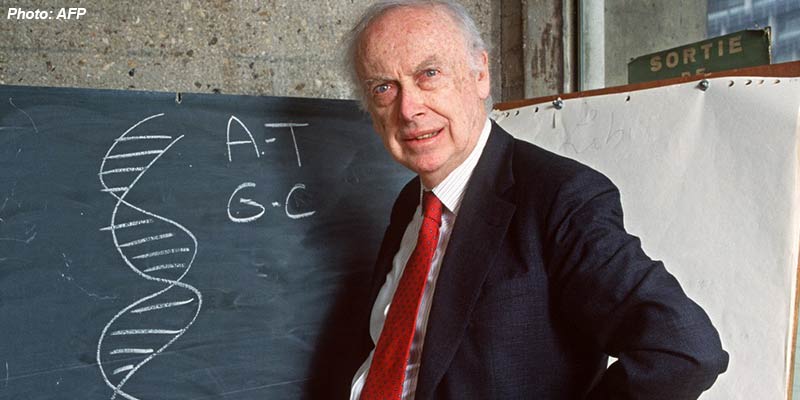
• James Watson, the American Nobel laureate co-credited with the pivotal discovery of DNA’s structure, passed away. He was 97.
• Watson shared a 1962 Nobel Prize with Francis Crick and Maurice Wilkins for discovering that deoxyribonucleic acid (DNA) is a double helix, consisting of two strands that coil around each other to create what resembles a long, gently twisting ladder.
Discovery of the shape of DNA
• James Dewey Watson was born in Chicago in Illinois, United States, on April 6, 1928.
• Watson completed his Bachelor of Science in Zoology in 1947 at the University of Chicago and began graduate work in the genetics laboratory of Salvador Luria at Indiana University, Indiana.
• He received a fellowship for graduate study in Zoology at Indiana University in Bloomington, where he received his PhD degree in Zoology in 1950.
• In May 2021, he met Maurice Wilkins and saw for the first time the X-ray diffraction pattern of crystalline DNA. This greatly stimulated him to change the direction of his research toward the structural chemistry of nucleic acids and proteins.
• Later, he met Francis Crick and discovered their common interest in solving the DNA structure.
• In March 1953, their efforts based upon more experimental evidence and better appreciation of the nucleic acid literature resulted in the proposal of the complementary double-helical configuration.
• The structure, as simple and elegant as it is profound, shows that two long strands of DNA run in opposite directions and spiral around one another in the shape of a double helix.
• Another vital element in the structure is that four organic bases — known as adenine, thymine, cytosine and guanine — are paired in a specific manner between the two helices in such a way as to provide a natural scaffold for the two strands.
• Along with Crick and Wilkins, he shared the 1962 Nobel Prize in Physiology or Medicine for their work.
• That marked a new era of modern life, allowing for revolutionary technologies in medicine, forensics and genetics — ranging from criminal DNA testing or genetically manipulated plants.
• ‘The Double Helix’ is the title of his memoir.
Key points on DNA:
• Deoxyribonucleic acid (DNA) is the molecule that carries genetic information for the development and functioning of an organism.
• DNA is made of two linked strands that wind around each other to resemble a twisted ladder — a shape known as a double helix.
• Each strand has a backbone made of alternating sugar (deoxyribose) and phosphate groups. Attached to each sugar is one of four bases: adenine (A), cytosine (C), guanine (G) or thymine (T).
• The two strands are connected by chemical bonds between the bases: adenine bonds with thymine, and cytosine bonds with guanine.
• The sequence of the bases along DNA’s backbone encodes biological information, such as the instructions for making a protein or RNA molecule.