
- World
- Aug 29
UNCCD COP17 concludes in Mongolia
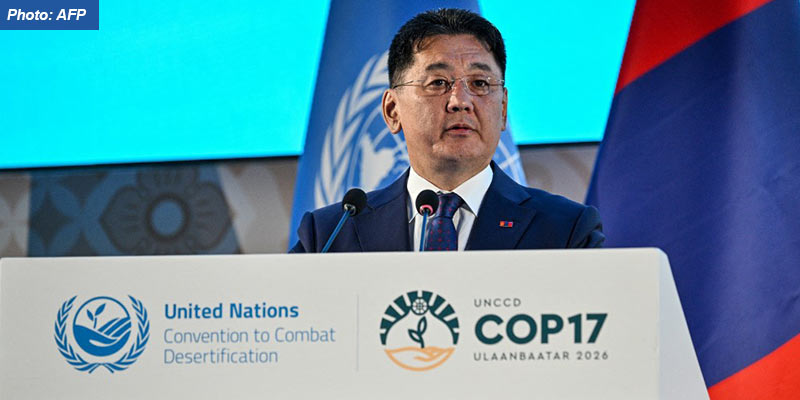
• After two weeks of negotiations on how to tackle land degradation, desertification and drought, the seventeenth session of the Conference of the Parties to the United Nations Convention to Combat Desertification (UNCCD COP17) concluded in Ulaanbaatar, Mongolia on August 28.
Key findings presented at COP17:
• Up to 40 per cent of the world’s land is degraded, while countries have committed to restoring more than one billion hectares by 2030.
• More than 70 countries now have national drought plans, compared with only three in 2013, but financing and implementation continue to lag behind the scale and speed of the challenge.
• Against this backdrop, Parties called for greater mobilisation of financial resources, capacity-building and technical cooperation to strengthen proactive drought management, particularly in African countries, without neglecting other affected developing countries.
• A significant body of new evidence presented in Ulaanbaatar highlighted both the costs of inaction and the benefits of investing in healthy land.
• New reports examined the economics of restoring the world’s rangelands, the growing human and economic impacts of drought, the particular challenges facing Small Island Developing States (SIDS) and Central Asia, and the value of investing in soil health.
• The findings showed that 18.8 million hectares of land are degraded across SIDS, while in Central Asia more than 80 million hectares — over a quarter of the region — are already degraded, affecting 24 million people.
• At the same time, all five Central Asian countries have adopted voluntary Land Degradation Neutrality targets, half of which have already been met.
• Together, the reports showed how land degradation and drought are affecting food and water security, livelihoods and economies across diverse regions, while making the economic case for prevention, sustainable land management and restoration.
• An estimated $355 billion a year is needed through 2030 to meet global land restoration commitments, compared with around $77 billion currently invested, leaving an annual financing gap of $278 billion. Private finance accounts for only around six per cent of global investment in land restoration.
Key outcomes of COP17:
• Governments, development banks, funds and companies announced a $1.3 billion portfolio of finance across 23 countries on five continents, at different stages of development.
• This includes $644.5 million identified as new finance, of which $216.4 million is already confirmed and moving towards implementation.
• The portfolio spans rangeland and landscape restoration, drought resilience and locally led adaptation.
• Following sustained negotiations, Parties decided to continue discussions at COP18, building on progress made at COP16 and COP17, with a view to adopting a decision on the proactive management of drought at all levels.
• Parties also decided that drought will remain a stand-alone agenda item at COP18 and at each ordinary session thereafter.
• The Riyadh Global Drought Resilience Partnership, established at COP16, moved towards implementation in Ulaanbaatar. Its first Assembly of Partners advanced work on a proposed pooled fund intended to help around 70 low and lower-middle-income countries through capacity-building, investment-ready programmes and financing for drought resilience.
• COP17 saw the launch of the Drought Resilience Investment Facility (DRIF), the first global catalytic financing platform dedicated to drought resilience. Co-created by UNCCD and Luxembourg with support from the International Drought Resilience Alliance, the Facility aims to mobilise up to $400 million in public and private capital for investments in water security, sustainable agriculture, nature-based solutions and land restoration. Its first strategic partnership with the Global Environment Facility will explore opportunities to unlock private and philanthropic finance.
• Phase II of the International Drought Resilience Observatory also introduced the world’s first Drought Resilience Index, providing countries with a new tool to assess their capacity to anticipate, prepare for and adapt to drought and to better target policies and investment.
• Host country Mongolia launched the first national Business 4 Land (B4L) Hub, alongside sustainable finance principles, a national green taxonomy and a target for 10 per cent green lending by 2030.
• The next session of the UNCCD Conference of the Parties (COP18) is expected to take place in Egypt in 2028, carrying forward the momentum built in Ulaanbaatar.