
- World
- Oct 05
3 win Nobel Prize in Physiology or Medicine for work on optogenetics
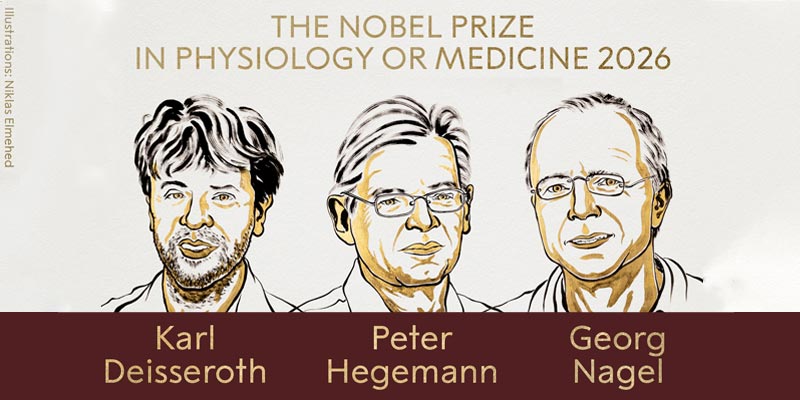
• The Nobel Prize in Physiology or Medicine 2026 was awarded jointly to American Karl Deisseroth, and Germans Peter Hegemann and Georg Nagel “for their discoveries concerning light-gated ion channels and optogenetics”.
• Their discoveries led to an incredibly powerful tool that has transformed neuroscience.
Who are the winners?
i) Karl Deisseroth was born 1971. He got PhD in 1998 and MD 2000 from Stanford University, USA. He is a professor of bioengineering and of psychiatry and behavioral sciences, at the Howard Hughes Medical Institute and Stanford University, USA.
ii) Peter Hegemann was born in 1954. He got PhD in 1984 from the Max-Planck-Institute for Biochemistry, Martinsried, Germany. He is a senior professor of neuroscience, Humboldt University of Berlin, Germany.
iii) Georg Nagel was born in 1953. He got PhD in 1988 from the University of Frankfurt, Germany. He is a professor of molecular plant physiology at the Department for Molecular Plant Physiology and Biophysics – Botany I, University of Wurzburg, Germany.
• The Nobel Prize in Physiology or Medicine is awarded by the Nobel Assembly at Karolinska Institutet, Stockholm, Sweden.
• The winners receive a prize sum of 12 million Swedish crowns ($1.2 million).
• Created in the will of Swedish dynamite inventor and businessman Alfred Nobel, the prizes have been awarded for breakthroughs in science, literature and peace since 1901, while economics is a later addition.
Foundation of a new era in neuroscience
• Optogenetics is a method that makes it possible to show how nerve cells shape memories, feelings and behaviours in the living brain.
• Peter Hegemann and Georg Nagel discovered a remarkable protein — channelrhodopsin — in a single-celled alga.
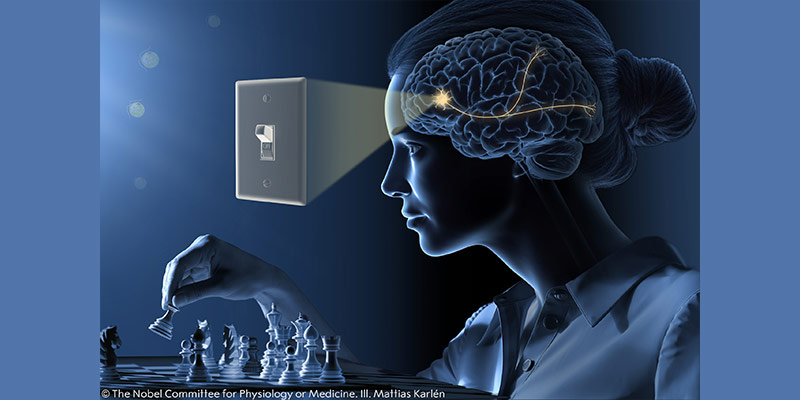
• Karl Deisseroth transformed the protein into a light-controlled switch for nerve cells.
• The laureates have laid the foundation of a new era in neuroscience.
• Optogenetics makes it possible to switch on, or off, the activity of individual nerve cells in a living brain.
Significance of the discovery
• How the brain governs feelings, behaviours and bodily functions has long been a mystery.
• In the 20th century, researchers began to investigate which areas of the brain affect which functions, but the methods used meant they could not prove causal relationships.
• The image they developed of the brain was like a sketch map, full of question marks and unknowns. Now all this is changing.
• It all began with Peter Hegemann’s curiosity. He wondered how Chlamydomonas, a single-celled alga, is able to swim towards a light source.
• In the early 2000s, he and Georg Nagel discovered channelrhodopsin, an algal protein with unique properties, found on the surface of the cell.
• When it is illuminated by blue light, a channel opens through the protein. Charged ions then flow into the cell, creating an electrical impulse.
• They found that regardless of which cell they put the protein in, those cells became light sensitive.
• Karl Deisseroth introduced the gene for channel-rhodopsin into nerve cells from rats. By illuminating the cells with blue light, he was able to trigger a nerve signal.
• He published this breakthrough in 2005. Two years later, he made this light-controlled switch for nerve cells work in the brains of living mice.
• This method for controlling nerve signals with light is now called optogenetics, and it has rapidly gained global impact.
• Using optogenetics, researchers have been able to reveal neural circuits governing specific memories, feelings, and behaviours relevant for neurological and psychiatric disorders.
• In clinical medicine, researchers are using the method in attempts to restore sight in people with visual impairment.
• There are also hopes that optogenetics could improve cochlea implants. Currently, these implants stimulate the auditory nerve using electricity. If it were instead possible to use optogenetics, the implant may be able to activate the auditory nerve with greater precision.
• Optogenetics has fundamentally altered our understanding of the brain.
• The hope that the knowledge generated by using optogenetics will lead to new medical treatments has begun to come to fruition.
• The method has provided greater understanding of the distinguishing features of psychiatric and neurological disorders such as depression, anxiety, schizophrenia, Alzheimer’s disease and Parkinson’s disease.
• Optogenetics continues to unravel one of humanity’s greatest mysteries: how the brain works.