
- World
- Oct 06
Francis Halzen wins 2026 Nobel Prize in Physics
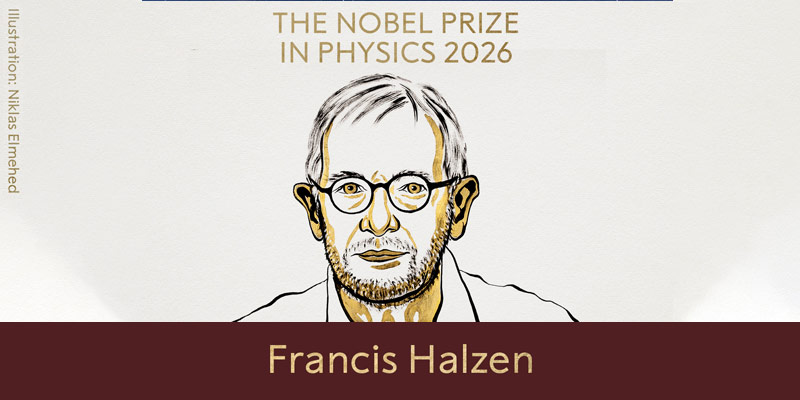
• Francis Halzen won the 2026 Nobel Prize in Physics “for decisive contributions to the IceCube Neutrino Observatory and the discovery of high-energy neutrinos of astrophysical origin”.
• Halzen was born in 1944 in Tienen, Belgium. He got his PhD in 1969 from KU Leuven, Belgium. He is now affiliated with the University of Wisconsin-Madison in the US.
• The winner of the Nobel physics prize is selected by the Royal Swedish Academy of Sciences and receives a prize sum totalling 12 million Swedish kronor ($1.2 million).
A neutrino telescope at the South Pole
• Halzen has laid the foundation for an entirely new type of astronomy.
• His idea was to use glacial ice at the South Pole to capture the secretive particles called neutrinos.
• The neutrino is the shyest particle in the universe. It has no electric charge and almost no mass. In general, it passes unnoticed through matter. Seldom does a neutrino make its presence felt by colliding with an atomic nucleus.
• Every second, without you noticing, 65 billion neutrinos from the Sun flow through your little finger nail.
• Neutrinos also come from other regions of space, carrying clues to some of the mysteries of the cosmos.
• Researchers that succeed in capturing these rarer cosmic neutrinos can then extract information about the extreme environments in the universe where they originated.
• Francis Halzen first presented his vision for capturing neutrinos at the South Pole in 1988.
• When a neutrino collides with an atomic nucleus, it produces a flash of light that can be tracked by sensors in the clear glacial ice.
• The South Pole’s ice has many advantages, as it is free from various types of interference and the area is geologically stable, with no earthquakes.
• Halzen and his idea soon gained the support of other researchers and, just a few years later, preliminary testing was conducted on sensors in ice.
• Within a few years, researchers from various institutions had gathered around Halzen to bring his idea of IceCube neutrino observatory in Antarctica to fruition.
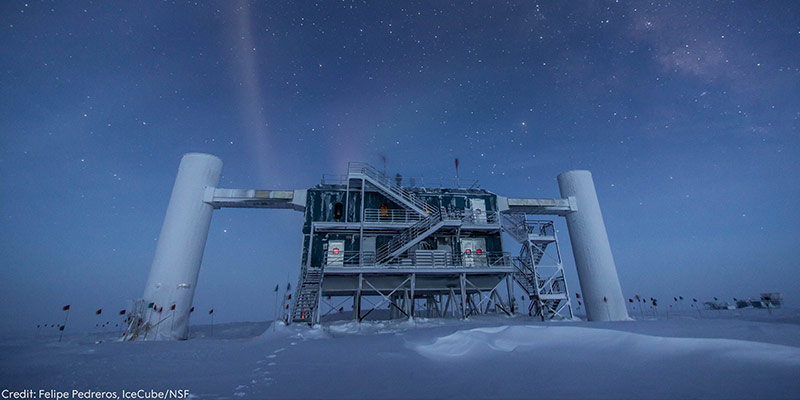
• IceCube — a cubic kilometre of ice equipped with light sensors — was finished in 2011.
• The IceCube Neutrino Observatory is located at a depth of 2 km in the polar ice, close to the Amundsen-Scott South Pole Station in Antarctica.
• IceCube is a National Science Foundation (NSF)-managed research facility, operated as an international collaboration involving 450 people from 58 institutions in 14 countries.
• Researchers soon discovered the first high-energy neutrinos and, a few years later, could publish their discovery of neutrinos that must originate far outside our solar system.
• The idea behind IceCube is to take neutrino astronomy to a new level, the hope being that neutrinos will provide information about phenomena that are hidden behind dust clouds, or objects that are so distant that other forms of radiation have disappeared along the way. The aim is to gain knowledge that cannot be obtained in any other way.