
- World
- Oct 07
France’s Henri Kagan, Japan’s Kenso Soai win Chemistry Nobel
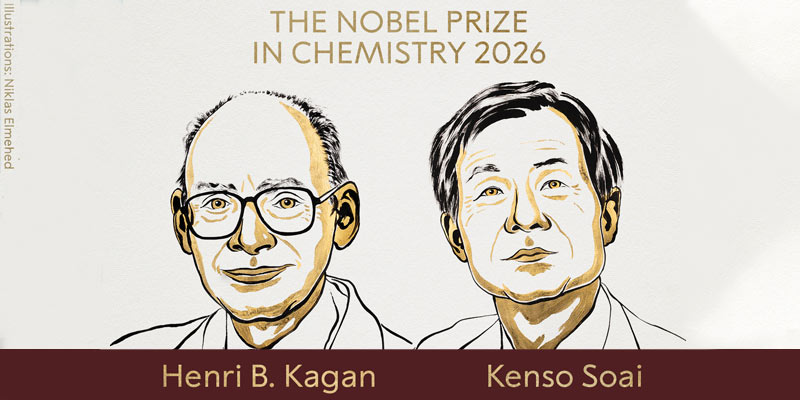
• France’s Henri Kagan and Japan’s Kenso Soai won the Nobel Prize in Chemistry.
The winners:
i) Henri Kagan was born in 1930 in Boulogne-Billancourt, France. He got PhD in 1960 from College de France, France. He is affiliated with Universite Paris-Sud in Orsay, France.
ii) Kenso Soai was born in 1950 in Hiroshima, Japan. He got PhD in 1979 from University of Tokyo, Japan. He is professor emeritus at Tokyo University of Science.
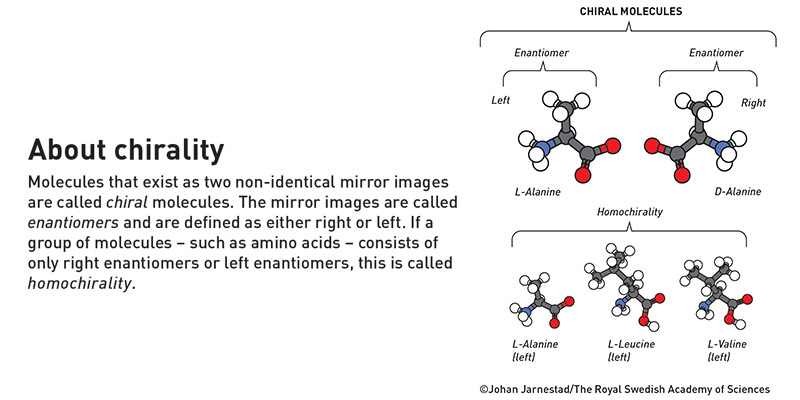
• Some molecules, such as amino acids, exist as two variants that are each other’s mirror image. However, living organisms only contain one of these mirror images.
• How chemical asymmetry such as this could have emerged was long a mystery to chemists.
• Kagan and Soai have been awarded for discovering a solution to this puzzle.
• Their discoveries are hugely important for chemists who design reactions that are utilised in applications such as pharmaceutical manufacturing.
They solved chemistry’s asymmetric mystery
• The molecules of life make things difficult for chemists.
• Imagine that you are a locksmith who makes keys to order. The problem is that when you produce them, you always end up with two mirrored variants, but only one of them fits the lock, and the lock can be damaged if your customers try to unlock it with the other key.
• Unfortunately, telling the keys apart is very difficult, so the customer gets them both.
• There are similar challenges when chemists develop new pharmaceuticals.
• Many of the drug molecules occur in two variants that are each other’s non-identical mirror image: one has the therapeutic effect, while the other can cause unnecessary and sometimes harmful side effects.
• The underlying reason for this is what chemists call homochiral, which comes from the Greek words for “same” and “hand”.
• Like hands, all amino acids exist as two mirrored variants, but only one of them is found in the proteins in your cells. The other is rarely found in nature.
• This is also true of the sugar molecules that are part of our DNA. There are two different mirror images of these molecules, but life only uses one.
• Henri Kagan took the first decisive step in 1986, when he discovered a new way of manipulating chemical reactions. This allowed him to create a greater excess of one of the mirror images than had previously been thought possible.
• His discovery has been revolutionary for chemists who develop reactions for the manufacture of pharmaceuticals, flavours, scents and new materials.
• Kenso Soai took the next step. He designed the first chemical reaction in which only one of the potential mirror images was formed. Other than life itself, no one had previously achieved this feat.
• The Soai reaction is one of the most spectacular chemical experiments ever conducted.
• The Soai reaction is artificial, different to the chemistry of life, but it awakened new enthusiasm in chemists who want to understand life’s origins.
• Around the world, researchers are now trying to repeat Soai’s achievement, but with the aim of producing homochiral amino acids and sugars.
• The non-linear effects that Kagan discovered have become an important tool for chemists when they design new reactions.
• The fact that a reaction is non-linear provides chemists with information about how it occurs.
• This information can be used to optimise the reaction, so they can obtain the purest possible enantiomers of the product.
• This is vital for every company that manufactures substances that are intended to interact with living beings, such as pharmaceuticals, flavours, scents and agricultural chemicals. In some cases, it is also important in the production of new materials.
• Thanks to the discoveries, chemists have gained fundamental new tools for use in their daily work but.
• Above all, these discoveries have contributed to solving one of chemistry’s greatest mysteries: how homochirality, like that found in all living beings, can be created.