
- World
- Oct 17
NASA’s Perseverance rover breaks record for off-planet driving on Mars
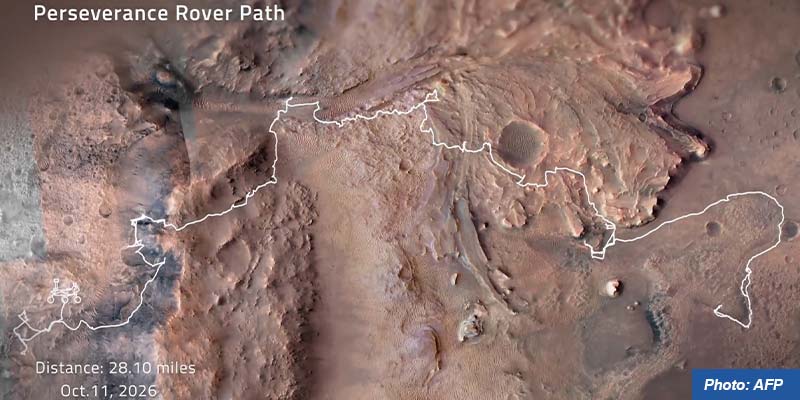
• NASA's Perseverance rover has set a record for the longest distance driven by any vehicle on a world beyond Earth.
• Perseverance reached the mark on the 2,006th Martian day (or sol) of its mission, covering since arriving on Mars on February 19, 2021.
When was Perseverance launched?
• Mars 2020: Perseverance Rover mission was launched on July 30, 2020 from Cape Canaveral Space Force Station in Florida.
• NASA chose Jezero Crater as the landing site for the Perseverance rover. Scientists believe the area was once flooded with water and was home to an ancient river delta.
• Jezero Crater is 45 kilometers wide, and is located on the western edge of a flat plain called Isidis Planitia, which lies just north of the Martian equator.
• The landing site is about 3,700 kilometers from the Curiosity rover landing site in Gale Crater.
• Perseverance rover is collecting core samples of Martian rock and regolith (broken rock and soil), for potential pickup by a future mission that would bring them to Earth for detailed study.
Key Discoveries
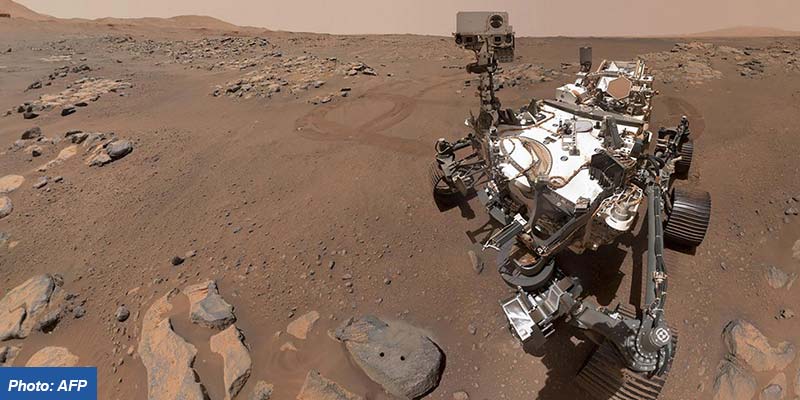
• During its first five years on the Martian surface, Perseverance collected more than two dozen geologically diverse rock samples.
• In the summer of 2024, Perseverance investigated its “most puzzling, complex, and potentially important rock yet”. It showed signs of past water, organic material, and clues suggesting chemical reactions by microbial life.
• In September 2025, after a rigorous, yearlong peer-review to scrutinise the Mars 2020 team findings, the journal ‘Nature’ published the validated results.
• Perseverance’s “Sapphire Canyon” sample from the rock nicknamed “Cheyava Falls” contains potential biosignatures — clues that suggest past life may have been present, but that require more data or further study before any conclusions about the absence or presence of life.
• The rover discovered a habitable, stable lake, delta, and river system in Jezero Crater’s history.
New milestone
• The milestone came as Perseverance traveled toward an area called “Idubi” through the region off the western rim of Jezero Crater nicknamed “Lac de Charmes,” where the rover is investigating what may be some of the oldest terrain ever explored in the solar system.
• The rocks and terrain of Lac de Charmes are so ancient that their Earthly equivalents have long since been erased by erosion and plate tectonics (Mars doesn’t have tectonic plates), and Idubi is where the science team hopes to find traces of ancient hydrothermal systems.
• Perseverance is one of two NASA rovers currently traversing the Martian surface, with the Curiosity rover operating in Gale Crater near the Martian equator.
• Curiosity has driven 38.15 km since landing on Mars in 2012.
• The extraterrestrial off-road driving record isn’t limited to Mars. Lunar driving records were broken earlier in the journey.
• Perseverance rolled past both the 35.7 kilometers covered by Apollo 17 astronauts Gene Cernan and Harrison Schmitt in 1972 and 39 kilometers driven by the Soviet Union’s Lunokhod 2 rover in 1973.
• Much of the credit belongs to Perseverance’s self-driving capability.
• Using an autonomous navigation system known as AutoNav, the rover images the terrain while rolling, builds a 3D map of hazards, and plots its course between waypoints selected by rover planners on Earth — a capability the team calls “thinking while driving”.
• Perseverance can do all that at or near its top speed, covering as much as 1,351 feet (412 meters) in a single sol.
• Perseverance builds on the 29-year legacy of NASA’s past Mars rovers — Sojourner, Spirit, Opportunity and Curiosity — each incorporating prior lessons and improving the ability to drive on another world.
• NASA recently approved an extension of the rover’s mission to explore the crater rim until roughly the end of 2028.