
- World
- Nov 02
Nations chart ‘Yerevan Pathway’ to speed up action for nature
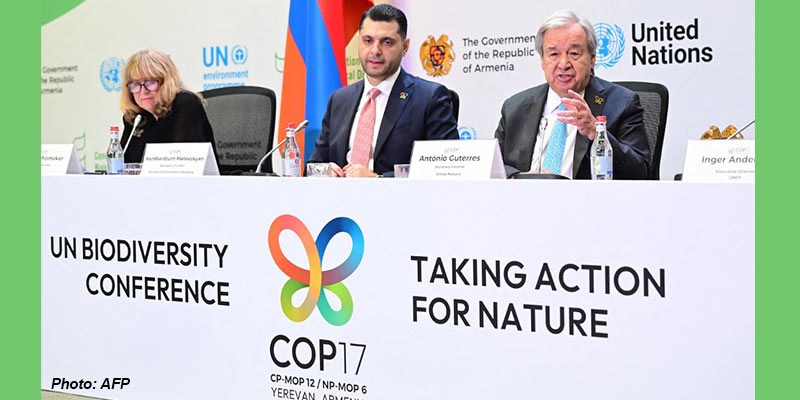
• The 17th meeting of the Conference of the Parties (COP17) to the Convention on Biological Diversity (CBD) was held in Yerevan, Armenia from October 19 to 30.
• It was held in conjunction with the 12th meeting of the Parties to the Cartagena Protocol on Biosafety (CP-MOP-12) and the sixth meeting of the Parties to the Nagoya Protocol on Access and Benefit-sharing (NP-MOP-6).
• COP17 marked the first global review of collective progress towards the implementation of the Kunming-Montreal Global Biodiversity Framework (KMGBF).
What is the Yerevan Pathway?
• One major outcome of COP17 was the Yerevan Pathway, a negotiated response to the outcome of the first global review of collective progress in the implementation of the KMGBF.
• The Yerevan Pathway sets out a shared response to those findings, identifying priorities for action through 2030 and areas where progress will need to be accelerated.
• These include tackling nature-harmful subsidies and incentives, increasing financial, scientific and technical support for developing countries, aligning national budgets and economic decisions with the
KMGBF, and strengthening implementation, monitoring, reporting and review mechanisms.
• The pathway calls on countries to tackle subsidies that harm nature and to increase financial, scientific and technical support for developing countries.
• It also calls for national budgets and economic decisions to be aligned with the framework, and for stronger monitoring and reporting.
Other key outcomes of COP17:
• Parties adopted nearly 50 decisions, covering areas including protected areas and forests, wildlife management, invasive alien species, marine and coastal biodiversity, and synthetic biology.
• Parties also agreed on the rules of operation for the new permanent subsidiary body on Article 8(j), officially named the ‘Sevan Guidelines’. These set the rules of operation for a new permanent body strengthening the role of Indigenous Peoples and local communities in shaping global biodiversity policy.
• Nearly $2 billion in new biodiversity funding was announced. This included $560 million under the Global Environment Facility’s latest replenishment and $500 million through the Species Recovery Alliance.
• Another $330 million is going to the Value Nature Fund, which aims to mobilise private capital for nature.
• Other initiatives included a new biodiversity bond and investment incubator launched by the Asian Development Bank, and new indicators to improve biodiversity monitoring and accountability.
• With four years remaining to achieve the world’s 23 biodiversity targets, attention now turns to implementing the decisions and commitments made in Yerevan.
• The Yerevan Pathway will help guide national efforts through 2030 with progress to be assessed through changes in policies, delivery of resources and measurable improvements for nature and people.
• The next Conference of Parties to the Convention on Biological Diversity (COP18) will be held in Ecuador with two years remaining to achieve the world’s biodiversity targets.
Convention on Biological Diversity
• The Earth’s biological resources are vital to our economic and social development but human activities are taking a toll on many animal and plant species. A legal framework exists for countries all over the world to protect biodiversity together: the Convention on Biological Diversity.
• The Convention on Biological Diversity (CBD) is the international legal instrument for “the conservation of biological diversity, the sustainable use of its components and the fair and equitable sharing of the benefits arising out of the utilisation of genetic resources” that has been ratified by 196 Parties (195 countries and the European Union).
• The text of the Convention was adopted on May 22, 1992 in Nairobi and was opened to signature on June 5, 1992, during the Rio Earth Summit. Within a year, it had received 168 signatures. It entered into force on December 29, 1993.
• With 196 Parties, the CBD has near universal participation among countries.
• The United States has not ratified the convention.
• The CBD's overall objective is to encourage actions, which will lead to a sustainable future.
• The Convention on Biological Diversity covers biodiversity at all levels: ecosystems, species and genetic resources.
• It also covers biotechnology, including through the Cartagena Protocol on Biosafety.
• In fact, it covers all possible domains that are directly or indirectly related to biodiversity and its role in development, ranging from science, politics and education to agriculture, business, culture and much more.
• The CBD’s governing body is the Conference of the Parties (COP). This ultimate authority of all governments (or Parties) that have ratified the treaty meets every two years to review progress, set priorities and commit to work plans.
• The Secretariat of the Convention on Biological Diversity (SCBD) is based in Montreal, Canada. Its main function is to assist governments in the implementation of the CBD and its programmes of work, to organise meetings, draft documents, and coordinate with other international organisations and collect and spread information. The Executive Secretary is the head of the Secretariat.
• On January 29, 2000, the Conference of the Parties to the CBD adopted a supplementary agreement to the Convention known as the Cartagena Protocol on Biosafety. It is an international agreement which aims to ensure the safe handling, transport and use of living modified organisms (LMOs) resulting from modern biotechnology that may have adverse effects on biological diversity, taking also into account risks to human health.
• The Nagoya Protocol on Access to Genetic Resources and the Fair and Equitable Sharing of Benefits Arising from their Utilisation (ABS) to the Convention on Biological Diversity is a supplementary agreement to the Convention on Biological Diversity. It is an international agreement which aims at sharing the benefits arising from the utilisation of genetic resources in a fair and equitable way. It entered into force on October 12, 2014.
• The Kunming-Montreal Global Biodiversity Framework was adopted in December 2022 in Montreal, Canada. It replaced the CBD’s Strategic Plan for Biodiversity 2011–2020 and its Aichi Targets. The framework consists of four global 2050 goals and 23 global 2030 targets.