
- World
- Nov 10
COP31 climate summit begins in Turkey’s Antalya
• The 31st UN Climate Change Conference (COP31) commenced in Antalya, Turkey on November 9.
• It will bring together world leaders and negotiators from the member states (or Parties) of the UN Framework Convention on Climate Change (UNFCCC) to further global progress.
• More than 90,000 people are expected in Antalya as pressure mounts to deliver on climate promises.
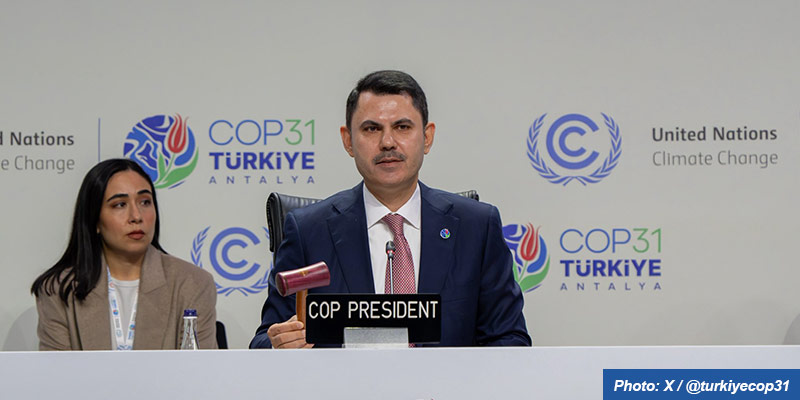
• Turkey’s Environment Minister Murat Kurum officially took the gavel as the COP31 President, while Australia’s Climate Change and Energy Minister Chris Bowen will oversee negotiations under an unusual co-presidency arrangement agreed during COP30.
• The summit will close on November 20.
What is COP31?
• The United Nations Framework Convention on Climate Change (UNFCCC) is a multilateral treaty adopted in 1992, shortly after the first assessment report by the Intergovernmental Panel on Climate Change (IPCC) in 1990, to stabilise greenhouse gas concentrations at a level that would prevent dangerous anthropogenic (human-induced) interference with the climate system.
• Since entering into force in 1994, the UNFCCC has provided the basis for international climate negotiations, including landmark agreements such as the Kyoto Protocol (1997) and the Paris Agreement (2015).
• The Conference of the Parties (COP) is the main decision-making body of the UNFCCC.
• UN Climate Change Conferences (or COPs) take place every year, and are the world’s only multilateral decision-making forum on climate change that brings together almost every country on Earth.
• The COP is where the world comes together to agree on the actions to address the climate crisis, such as limiting the global temperature rise to 1.5°C, helping vulnerable communities adapt to the effects of climate change, and achieving net-zero emissions by 2050.
• The inaugural COP gathering took place in Berlin, Germany, in March 1995, and today the COP secretariat is headquartered in Bonn.
• The host country of the COP normally rotates among the five United Nations regional groups (Africa, Asia-Pacific, Eastern Europe, Latin American and the Caribbean, and Western European and Others), with regional group members determining which country from their region will make an offer to host the conference.
• COP30 was held in Brazil’s Belem in November 2025.
• Officially, COP31 stands for the 31st meeting of the Conference of the Parties (COP) to the UNFCCC.
Landmark agreements from previous COPs
• COPs have created global milestones for the climate movement, setting standards and advancing action, including on reducing carbon emissions, accelerating a global energy transition, and helping countries adapt and build resilience to compounding climate issues.
i) 1997 Kyoto Protocol — First legally binding emissions targets for industrialised countries.
ii) 2015 Paris Agreement — All Parties committed to limit warming below 2°C (compared to pre-industrial levels) and pursue 1.5°C.
iii) Loss and Damage Fund at COP27 — The fund aims to provide financial assistance to nations most vulnerable and impacted by the effects of climate change.
• Over three decades, COP decisions have shaped national laws, clean energy investments and climate programmes across the world.
Why is COP31 important?
• Negotiations on issues such as adapting to climate impacts, reducing greenhouse gas pollution, climate finance for developing countries, and a just transition for workers and communities will take place.
• This year will also see a big emphasis on the Climate Action Agenda: a separate, yet complementary track at COP31, which brings together businesses, cities, states and civil society to find and share solutions to climate issues including climate impacts on health and food, electrifying everything from buildings to cars, reducing waste and making cities more resilient to climate change.
• Cooperation between nations is essential if we want to solve this global problem.
• Climate negotiations have already made significant progress bringing down global heating projections from over 4°C to 2.6°C. But more and faster action is needed to protect all people and economies.
• COP31 is all about implementation of climate solutions and progressing a global energy transition that drives economic growth, more jobs, food security, better health and safety and affordable clean energy.
• No single COP can solve the climate crisis alone. But each COP builds on the last and has taken major steps forward.